


Why 4.5 Tonnes? The Thinking Behind the New Ultra® 4500kg Car Transporter
October 14, 2026
.webp)
The vehicles that professional transport and recovery operators are being asked to move are changing.
Larger cars, SUVs, hybrids and battery electric vehicles all form an increasingly important part of the modern vehicle mix, and many of those vehicles place greater demands on the carrying capacity available from a transporter.
For operators running 3.5 tonne vehicles, that can create a practical question.
What happens when the transporter that works perfectly well for much of your workload no longer gives you the flexibility you need for some of the vehicles you are increasingly being asked to move?
Moving immediately to a much larger vehicle is one answer.
But it is not necessarily the only answer.
That is the thinking behind the AKFS Ultra® 4500kg GVW Car Transporter.
Rather than simply increasing the gross vehicle weight for the sake of creating another model, the Ultra® 4500kg has been developed to occupy a very deliberate position between the established 3500kg Ultra® and larger 7200kg vehicle transporters.
It is a vehicle designed around the changing realities of day-to-day vehicle transport.
And, perhaps most importantly, it is designed around the typical vehicle, not the extremes.
Why Are Vehicle Weights Becoming More Important for Transport Operators?
Vehicle transport has always required operators to understand the weight of the vehicle being carried.
But that consideration is becoming increasingly important as the mix of vehicles on UK roads changes.
Modern cars vary significantly in size, specification and weight. Larger SUVs, hybrid powertrains and battery electric vehicles can all increase the demands placed on a transporter, particularly when compared with smaller conventional cars.
Many battery electric vehicles, for example, are heavier than equivalent or similarly sized petrol and diesel vehicles because of the mass associated with their battery systems.
That does not mean every electric vehicle is particularly heavy, and it certainly does not mean every EV requires a larger transporter.
It does mean operators need to look carefully at the actual vehicles they are being asked to move rather than assuming that yesterday’s transport specification will automatically suit tomorrow’s workload.
For businesses operating vehicle recovery fleets, dealership transport, bodyshop collections, vehicle logistics or insurance-related movements, those changes can influence which jobs a particular transporter can safely and legally undertake.
Where Can a 3.5 Tonne Car Transporter Become Restrictive?
A 3500kg GVW transporter remains the right solution for many vehicle transport operators.
The AKFS Ultra® 3500kg, for example, has been developed specifically to make effective use of the 3.5 tonne category through lightweight engineering and a payload-efficient conversion.
But GVW is not the same thing as payload.
The vehicle’s own weight, body conversion, driver, fuel, fluids, fitted equipment and operating specification all contribute towards the total gross vehicle weight.
What remains is the carrying capacity available for the vehicle being transported.
As the weight of the vehicle being carried increases, that available margin naturally becomes more important.
For some operators, the result is that a 3.5 tonne transporter may continue to handle a significant proportion of the work perfectly well while becoming restrictive on heavier movements.
The question then becomes whether the next step needs to be a much larger transporter.
Bridging the Gap Between 3.5 Tonnes and 7.2 Tonnes
This is where the Ultra® 4500kg has a very specific role.
The 4.5 tonne model has been developed to provide an additional option between a 3.5 tonne transporter and larger 7.2 tonne vehicles.
That gap matters.
For many fleets, the traditional progression has effectively been from a lightweight 3.5 tonne transporter to a substantially larger vehicle offering far more carrying capacity.
There will always be work that genuinely requires that larger platform.
But not every vehicle movement does.
If a fleet regularly encounters vehicles that sit beyond the comfortable operating capability of its 3.5 tonne transporters but does not need the full capacity of a 7.2 tonne vehicle for every job, a 4.5 tonne transporter can give the operator another way to structure the fleet.
Tom McGeown, AKFS Product Specialist for Car Transporters, describes the opportunity in simple terms: it is about giving operators something between the two categories, rather than forcing every heavier movement onto a much larger vehicle.
That is not just a payload discussion.
It is a fleet-utilisation discussion.
Built for the Typical Vehicle, Not the Extremes
This is probably the most important point to understand about the Ultra® 4500kg.
It has not been designed to replace every larger transporter.
Nor has it been developed around the heaviest or most unusual vehicle an operator might conceivably be asked to carry.
It is designed around the typical vehicle, not the extremes.
Tom’s view during the development work was that the opportunity sits with the mainstream vehicles operators are moving every day rather than the exceptional cases at either end of the market.
That changes how the product should be judged.
Instead of asking:
“What is the biggest vehicle this transporter could possibly carry?”
a more useful question is:
“What proportion of my everyday workload could this vehicle handle efficiently, safely and legally?”
That is a far more commercially useful way to think about fleet specification.
The right vehicle is not necessarily the largest vehicle available.
It is the vehicle that is best matched to the work it will perform most frequently.
Why Right-Sizing a Vehicle Transporter Matters
Fleet efficiency is not simply about having enough carrying capacity.
It is also about deploying the right asset for the job.
A larger transporter provides greater capacity, but that additional capability may not be necessary for every vehicle movement.
Equally, a 3.5 tonne transporter may be ideal for lighter work but may begin to limit flexibility where heavier vehicles become a greater part of the workload.
The Ultra® 4500kg creates another option between those two positions.
For a fleet operator, that can mean having a vehicle available for movements that are too demanding for a 3.5 tonne platform without automatically allocating a larger 7.2 tonne transporter.
Tom identified this fleet-mix point as one of the strongest commercial arguments for the vehicle during the development of the launch proposition.
In practical terms, the question becomes:
“Is the transporter appropriately sized for the work it is being asked to do?”
That is the same principle that should sit behind any commercial vehicle investment.
Why the AL-KO Chassis Conversion Matters
The Ultra® 4500kg story is not simply about increasing GVW.
The engineering underneath the conversion matters just as much.
The vehicle combines a Fiat Ducato cab with a proven AL-KO chassis conversion and an AKFS lightweight transporter body.
AL-KO develops lightweight commercial-vehicle chassis specifically to give bodybuilders flexibility around wheelbase, frame length, overhang and body configuration. Its commercial chassis systems are also designed to support higher permissible gross weights while maintaining appropriate axle-load distribution and vehicle stability.
For vehicle transporter applications, that flexibility is particularly useful.
The chassis can provide the basis for an extended loading platform while maintaining a lightweight structure, and AL-KO specifically identifies car transporters as one of the applications suited to its commercial chassis technology.
AL-KO chassis technology also incorporates torsion-bar suspension and lightweight galvanised construction, both of which support the wider objective of balancing durability, vehicle weight and driving characteristics.
For the Ultra® 4500kg, AKFS and AL-KO have worked around the chassis configuration, wheelbase, suspension and overall package with the aim of balancing carrying capacity, performance and everyday usability.
That is an important distinction.
The objective is not simply to create the highest possible headline number.
It is to create a transporter that works as a complete vehicle.
Lightweight Engineering Still Matters at 4500kg GVW
Moving from 3500kg to 4500kg GVW provides more available vehicle mass, but that does not mean conversion weight stops mattering.
Quite the opposite.
Every kilogram used by the chassis, body, equipment and accessories contributes towards the finished operating weight of the transporter.
That is why lightweight engineering remains central to the Ultra® philosophy.
The Ultra® 4500kg has an unladen weight from 2052kg, although the final operating weight and available payload will always depend on specification, fitted options, driver, fuel, fluids and other operational factors.
Tom’s own development figures demonstrated why one blanket payload number would be misleading. He recorded an unladen weight of 2052kg for a lightly specified vehicle and around 2186kg for a recovery specification, with actual payload varying accordingly.
That is why payload should always be assessed against the finished vehicle specification rather than treated as a theoretical subtraction from GVW.
Payload Is More Than a Headline Figure
When buying any vehicle transporter, payload deserves careful attention.
But a headline payload figure only tells part of the story.
Operators also need to consider the real working vehicle.
That includes:
- driver
- fuel and fluids
- winch equipment
- storage
- lighting
- recovery equipment
- securing equipment
- optional accessories
- any other items carried during normal operation
A transporter should be specified around realistic working conditions rather than the lightest theoretical configuration.
The same principle already runs through AKFS guidance on vehicle specification more generally: the correct vehicle is the one capable of carrying the required load safely while remaining practical for the work it performs.
Practical Loading for Everyday Vehicle Transport
Carrying capacity is only useful if the transporter is practical to use.
The Ultra® 4500kg therefore combines its increased GVW with a loading specification developed around professional vehicle transport.
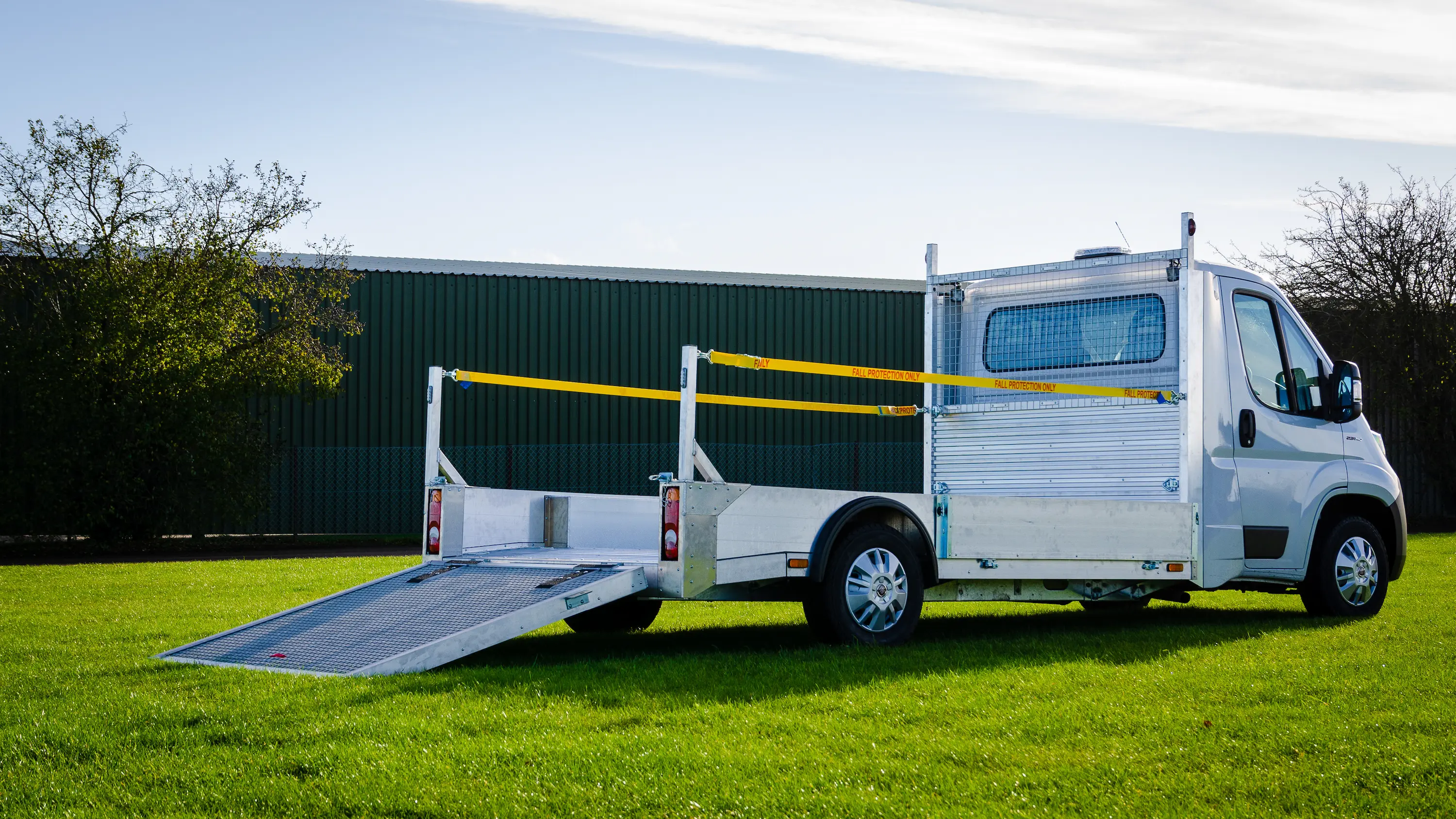
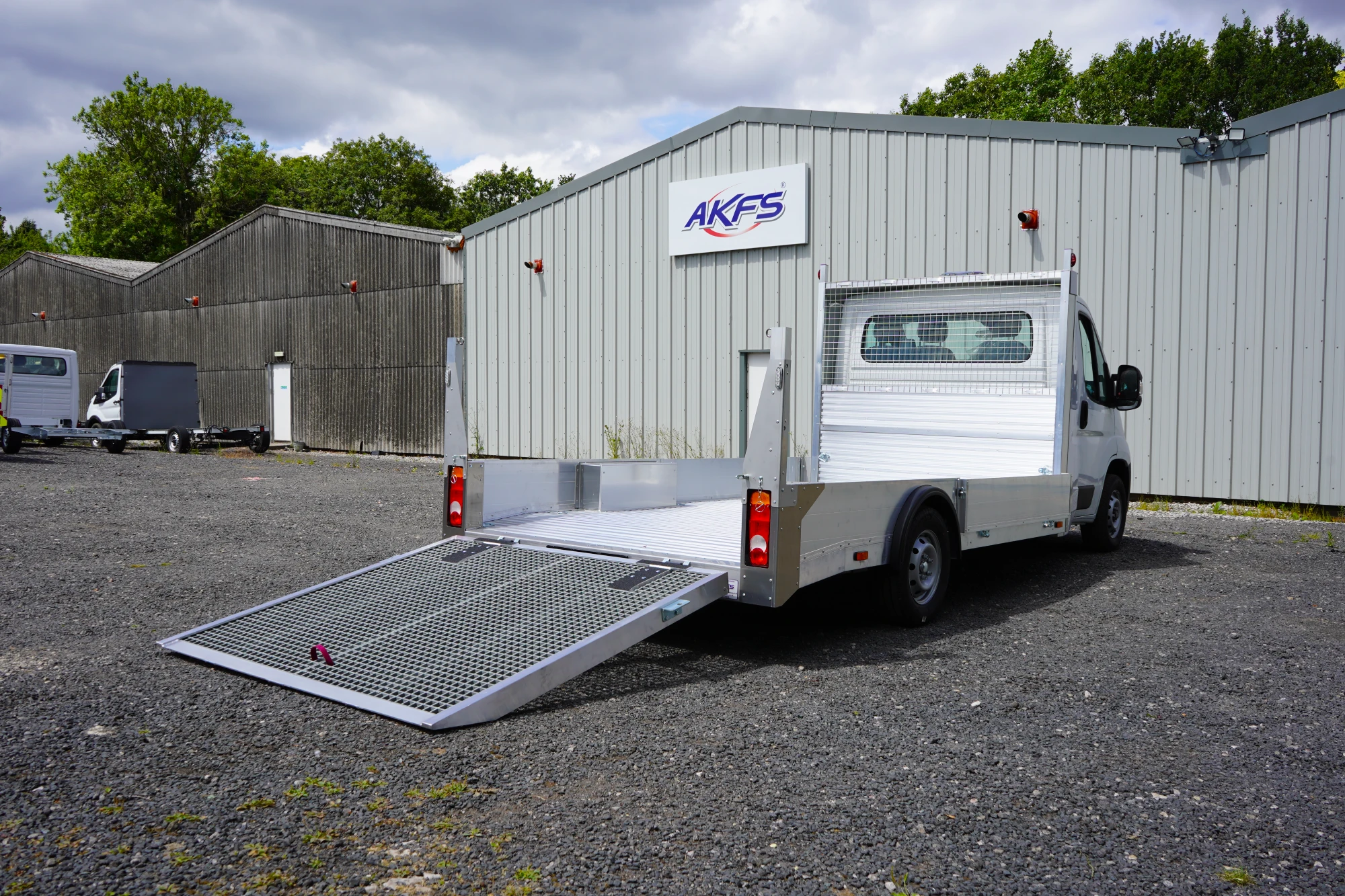
Standard equipment includes 8-foot load-certified aluminium ramps with built-in helper ramps, a 3+3 plank bed, eight surface-mounted securing points, vehicle securing straps and an aluminium front crash bar.
Optional equipment includes an electric winch system with wireless remote upgrade, punched decking for over-wheel securing straps, storage, lighting options, a closed deck, wheel chocks and rear parking sensors.
The aim is not simply to create a transporter that can carry more.
It is to create one that can be configured around how an operator actually loads, secures and moves vehicles day to day.
Who Is the Ultra® 4500kg Designed For?
The Ultra® 4500kg is intended for professional operators whose workload increasingly includes heavier mainstream vehicles.
That could include:
- vehicle recovery businesses
- dealerships
- bodyshops
- vehicle logistics operators
- insurance-related transport operations
- professional vehicle transport fleets
The common factor is not the sector itself.
It is the requirement for more carrying capacity than a 3.5 tonne transporter can provide comfortably across the operator’s typical workload, without automatically needing the capacity of a larger 7.2 tonne vehicle for every movement.
Is a 3.5 Tonne or 4.5 Tonne Car Transporter Right for Your Business?
There is no universal answer.
For many operators, the Ultra® 3500kg will remain exactly the right vehicle.
If the cars you regularly transport sit comfortably within its usable carrying capacity, there is little reason to move away from a lightweight 3.5 tonne solution simply because a higher-GVW model exists.
The Ultra® 4500kg becomes relevant when the workload changes.
You may want to consider the 4.5 tonne option if:
- heavier vehicles are becoming a more regular part of your work
- vehicle weight is starting to restrict the jobs you can accept
- your fleet currently jumps from 3.5 tonne directly to larger 7.2 tonne transporters
- you want an intermediate vehicle for mainstream heavier movements
- you are reviewing fleet utilisation and want vehicles more closely matched to individual jobs
That decision should always be based on the vehicles you move, the specification of the transporter and the way it will operate in service.
What Should You Consider Before Specifying a 4.5 Tonne Car Transporter?
Before selecting a transporter, look at your real workload rather than simply choosing a GVW category.
Consider:
- the vehicles you transport most frequently
- their actual kerb weights
- whether EVs, hybrids or larger SUVs are becoming more common
- the equipment normally carried on the transporter
- winch and recovery requirements
- loading and securing preferences
- storage requirements
- annual mileage
- whether the vehicle forms part of a mixed fleet
- how frequently a larger 7.2 tonne transporter is genuinely required
That information gives your converter a much stronger basis for specifying the right vehicle.
It also helps prevent two common problems: buying too little capability for the workload or buying far more vehicle than the operation routinely needs.
A Transporter Designed Around Real-World Work
The Ultra® 4500kg is not about replacing the 3500kg Ultra®.
It is not about replacing every 7.2 tonne transporter either.
It is about filling the space between them.
For operators whose workload is changing, that extra option can be valuable.
The vehicle combines a 4500kg GVW platform with the lightweight engineering philosophy of the Ultra® range, a Fiat Ducato cab, AL-KO chassis conversion and an AKFS body designed around professional vehicle transport.
Most importantly, the proposition is straightforward:
Built for the typical vehicle, not the extremes.
For the vehicles operators are moving every day, the Ultra® 4500kg provides another way to match the transporter to the work.
Is the Ultra® 4500kg Right for Your Operation?
The best way to answer that question is to look at your actual vehicle mix.
If your current 3.5 tonne transporter continues to meet your requirements, it may still be the right solution.
If heavier vehicles are increasingly restricting the work you can accept, the Ultra® 4500kg may provide the additional carrying capacity and operational flexibility you need without automatically stepping into a much larger transporter.
Speak with Tom McGeown, AKFS Product Specialist – Car Transporters & Minibus, to compare the Ultra® 3500kg and Ultra® 4500kg and discuss the most appropriate specification for your operation.
07483 947330
tom.mcgeown@advanced-kfs.co.uk
Make An Enquiry
Download A Brochure
You Might Also Be Interested In
.webp)
.webp)
Get In Touch With A Product Specialist Today
Here at AKFS our team of professionals are ready to answer any queries you may have. Get in touch or download a brochure to find out more today.
